
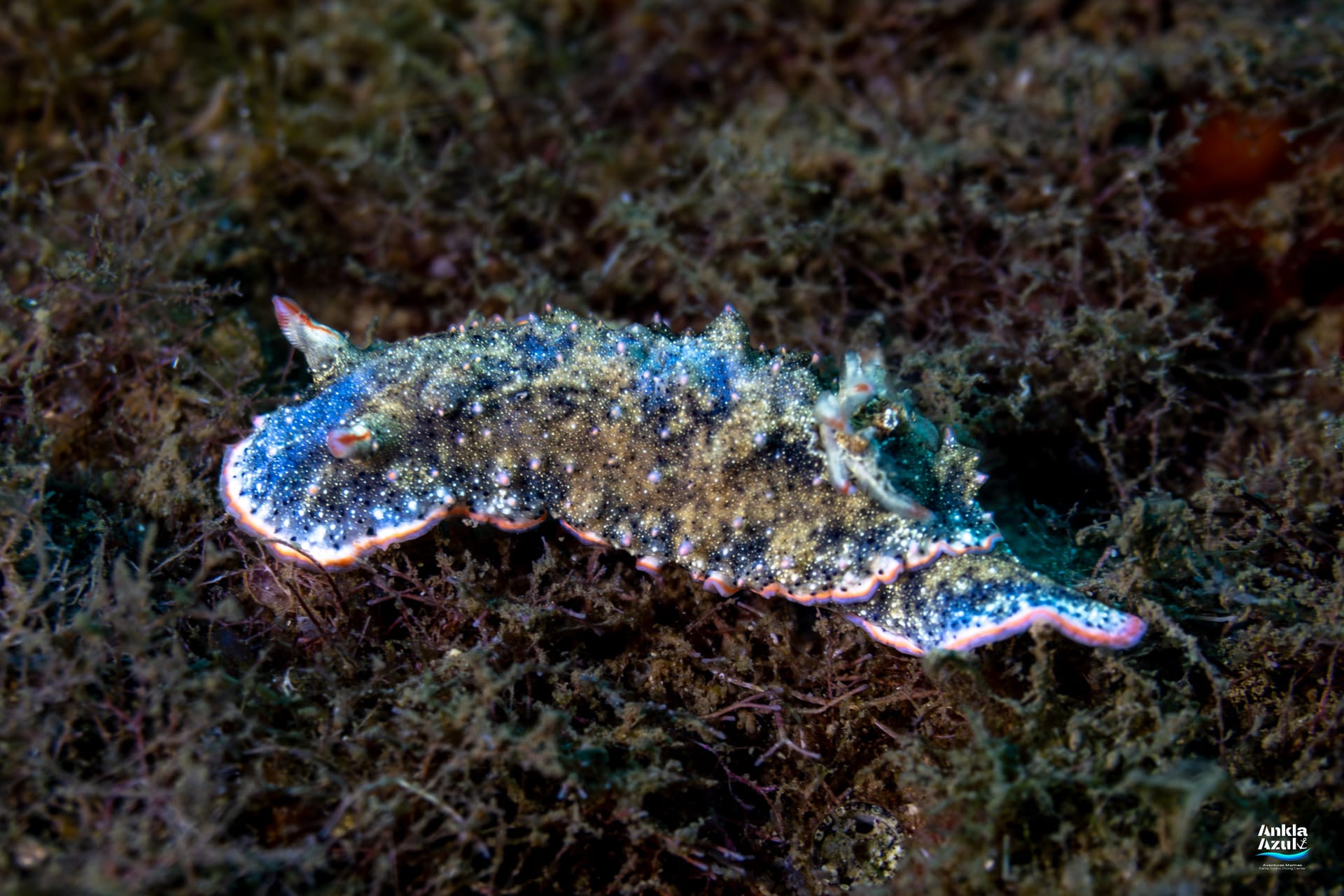
Agassiz’s Nudibranch
Felimare agassizii
Family: Chromodorididae
Size: Up to 8 cm (3 in) | Common: 4 cm
Depth: 1 – 30m (3 – 100ft)
Distribution: Eastern Pacific (Gulf of California to Peru, including the Galapagos and Malpelo).
Identification: A stunning, highly photogenic sea slug with vibrant warning colors.
- Color & Pattern: The main body is dark blue, black, or deep brown, densely covered in small yellow or white spots.
- The Margin: The "skirt" (mantle edge) is incredibly distinct: it features a bright orange or red outer band, followed by a white inner band.
- Anatomy: Look for the sensory tentacles on its head (rhinophores) and the feathery gills on its back (branchial plume), which are usually dark blue or purple with bright orange/red tips.
Behavior: A slow-moving specialist with a toxic defense.
- Diet: Like many nudibranchs, they are highly specialized feeders. They graze almost exclusively on specific types of sponges found on the rocky reefs.
- Defense Mechanism: They don't need a shell because they absorb the toxic chemicals from the sponges they eat. Their brilliant neon colors act as a visual warning (aposematism) to let predators know they taste terrible and are poisonous.
You just learned about this fish...
NOW COME SEE IT!
Behind the Lens
Jalvan
Underwater Photographer & Instructor
Documenting unique marine biodiversity from the Red Sea across the Pacific Ocean. Dedicated to creating a visual catalog of Bahia Solano's marine life for conservation and research.
Video: Osmo Action 5 Pro | GoPro
Follow my work:

advertisement
REFERENCES & DATA SOURCES
Scientific ID: Verified via FishBase (Froese & Pauly, 2024).
Field Guide: Reef Fish Identification: Baja to Panama (Humann & DeLoach).
Conservation Status: IUCN Red List (Least Concern).
Regional Data: Ankla Azul Marine Observation Log (Bahia Solano).
More Than Kicking Your Fins
At Ankla Azul, diving is more than kicking your fins. It's patient teaching, sharp safety, and real care for the place we call home. As an SSI Instructor Training Center and an SSI Blue Oceans Center (2025 award), we blend skill-building with ocean awareness—Fish ID, coral nursery work, community education, and rescue support—so every dive grows confidence and respect for Bahía Solano's wild Pacific.