Pacific Creolefish
Paranthias colonus
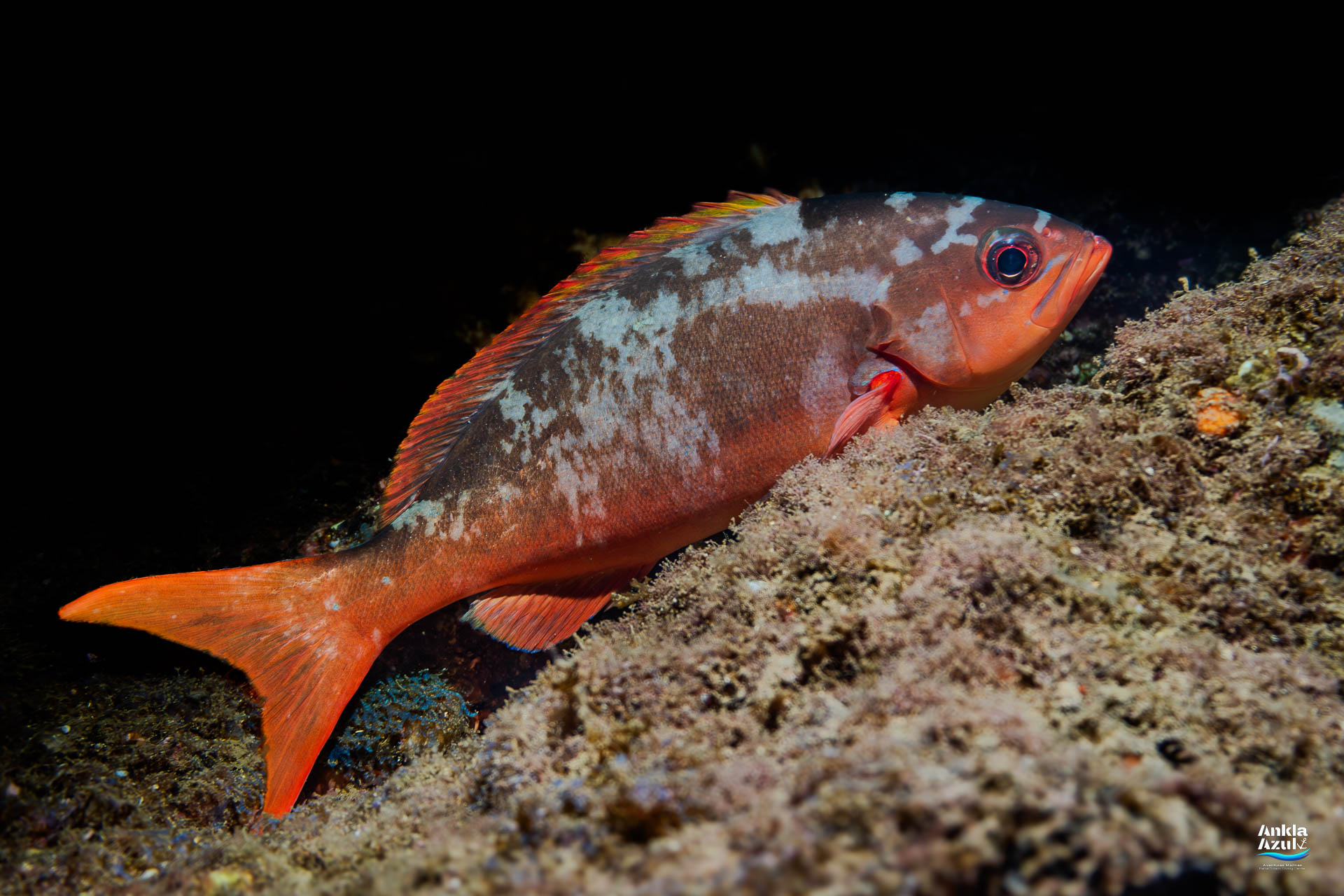
Adult
Family: Sea Basses & Groupers (Serranidae)
Size: Up to 35 cm (14 in) | Common: 25 cm
Depth: 3 – 100m (10 – 330ft)
Distribution: Gulf of California to Peru (including Galapagos & Malpelo).
Identification: A grouper that thinks it's a snapper, with distinct day and night phases.
- Daytime Phase: When actively schooling in the water column, their torpedo-shaped bodies are a sleek silvery-blue with striking red fins and a deeply forked red tail.
- Night / Resting Phase: To hide from predators in the dark, they change their skin to a reddish-brown or pinkish-grey camouflage. The key feature in this phase is a row of 4 or 5 distinct white/pale spots along the back.
Behavior: The "Wall of Mouths."
- Schooling & Feeding: During the day, they are planktivores. They form massive walls of thousands of fish hovering above the reef, facing the current to snap up passing zooplankton.
- Nighttime: When the sun goes down (or when threatened by a predator), they instantly dart down into the reef crevices, shutting down their bright silvery colors to blend in with the rocks.
- Ecological Role: They are a primary food source for larger predators like Snappers, Jacks, and Sharks.
You just learned about this fish...
NOW COME SEE IT!
Behind the Lens
Jalvan
Underwater Photographer & Instructor
Documenting unique marine biodiversity from the Red Sea across the Pacific Ocean. Dedicated to creating a visual catalog of Bahia Solano's marine life for conservation and research.
Video: Osmo Action 5 Pro | GoPro
Follow my work:
advertisement
REFERENCES & DATA SOURCES
Scientific ID: Verified via FishBase (Froese & Pauly, 2024).
Field Guide: Reef Fish Identification: Baja to Panama (Humann & DeLoach).
Conservation Status: IUCN Red List (Least Concern).
Regional Data: Ankla Azul Marine Observation Log (Bahia Solano).
More Than Kicking Your Fins
At Ankla Azul, diving is more than kicking your fins. It's patient teaching, sharp safety, and real care for the place we call home. As an SSI Instructor Training Center and an SSI Blue Oceans Center (2025 award), we blend skill-building with ocean awareness—Fish ID, coral nursery work, community education, and rescue support—so every dive grows confidence and respect for Bahía Solano's wild Pacific.