
Sabertooth Blenny
Plagiotremus azaleus
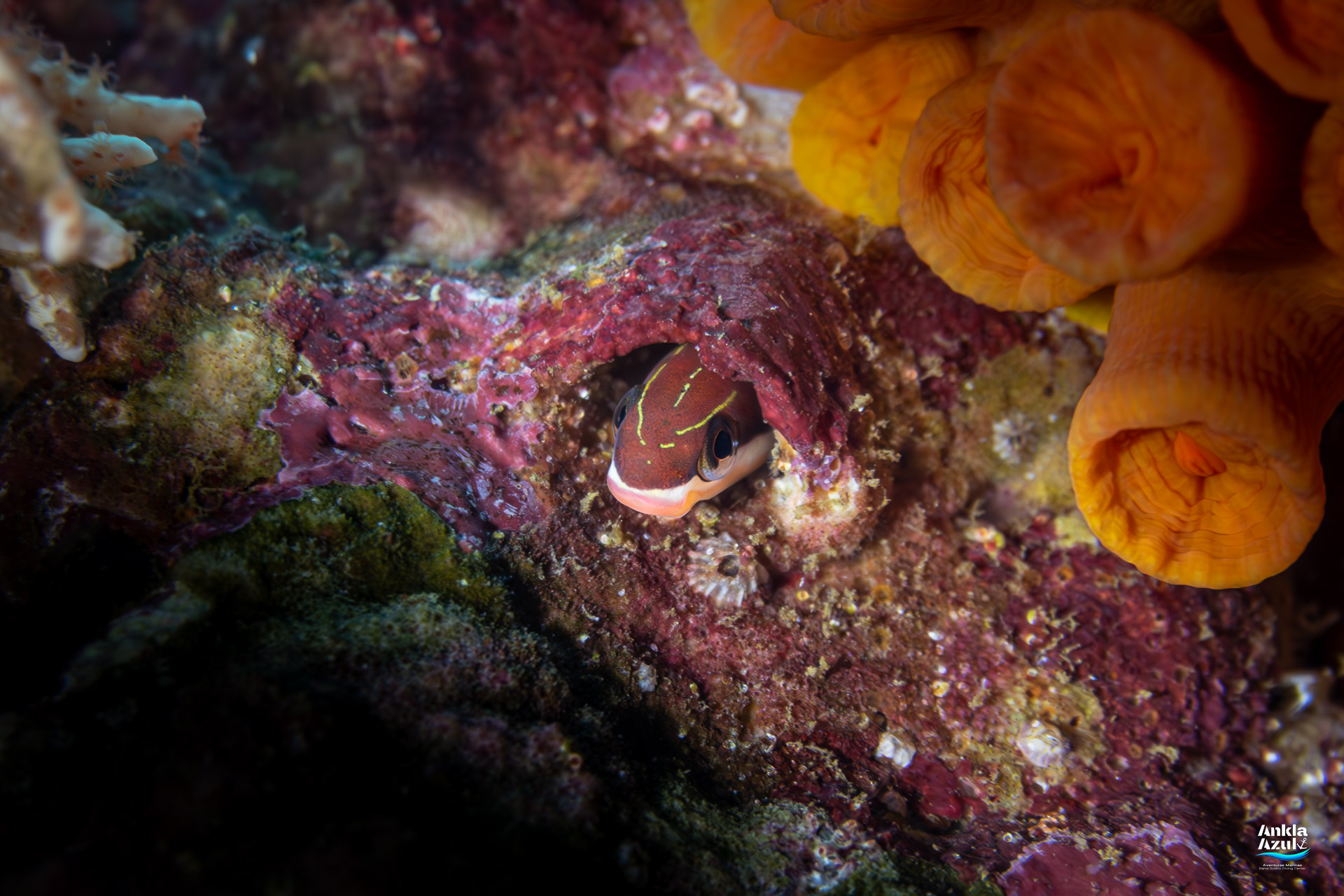
Adult
Family: Combtooth Blennies (Blenniidae)
Size: Up to 10 cm (4 in) | Common: 7 cm
Depth: 3 – 25m (10 – 80ft)
Distribution: Eastern Pacific (Gulf of California to Peru & Galapagos).
Identification:
A deceptive fish that relies on mimicry and hiding.
- In the Tube (Pictured): When resting, they reverse into empty worm tubes or barnacle shells. You will only see the head, which is brownish with a distinct yellow or pale stripe running horizontally just above the eye.
- Swimming: When swimming, they look incredibly similar to the juvenile Cortez Rainbow Wrasse. They have a slender body with a broad dark stripe and a yellow stripe on top.
Behavior:
The "wolf in sheep's clothing."
- Aggressive Mimicry: They copy the swimming pattern of beneficial cleaner wrasses to gain the trust of larger fish. Once close, they don't clean—they attack!
- Diet: They are "scale-eaters." They use their large, curved canine teeth (fangs) to take quick bites of fin or skin from unsuspecting fish before darting back to safety.
You just learned about this fish...
NOW COME SEE IT!


Behind the Lens
Jalvan
Underwater Photographer & Instructor
Documenting unique marine biodiversity from the Red Sea across the Pacific Ocean. Dedicated to creating a visual catalog of Bahia Solano's marine life for conservation and research.
Video: Osmo Action 5 Pro | GoPro
Follow my work:

advertisement
REFERENCES & DATA SOURCES
- Scientific ID: Verified via FishBase.
- Field Guide: Reef Fish Identification: Baja to Panama (Humann & DeLoach).
- Regional Data: Ankla Azul Marine Observation Log (Bahia Solano).
More Than Kicking Your Fins
At Ankla Azul, diving is more than kicking your fins. It's patient teaching, sharp safety, and real care for the place we call home. As an SSI Instructor Training Center and an SSI Blue Oceans Center (2025 award), we blend skill-building with ocean awareness—Fish ID, coral nursery work, community education, and rescue support—so every dive grows confidence and respect for Bahía Solano's wild Pacific.